

How to Present Logo Concepts to Clients So Approvals Come Faster
Present logo concepts so clients approve faster. Show two or three strong options with clear reasoning, real mockups, and one simple decision step.
- Written by Asad Farooq
- Topic: Branding
- Published
- 5 min read
Key takeaways
- Show two or three strong concepts, never ten weak ones, so the client can compare real options instead of guessing.
- Explain every concept in plain language, linking each choice to the business, the customer, and the problem it solves.
- Present logos in real contexts, such as a website header, a social media avatar, and a shop sign, not only on a blank slide.
- Name one concept as your recommendation and say why, because clients approve faster when the expert takes a clear position.
- End with one simple decision step, such as approving a direction or asking for one named change, so the meeting ends with progress.
In this article (6 sections)
Show two or three concepts, not a gallery
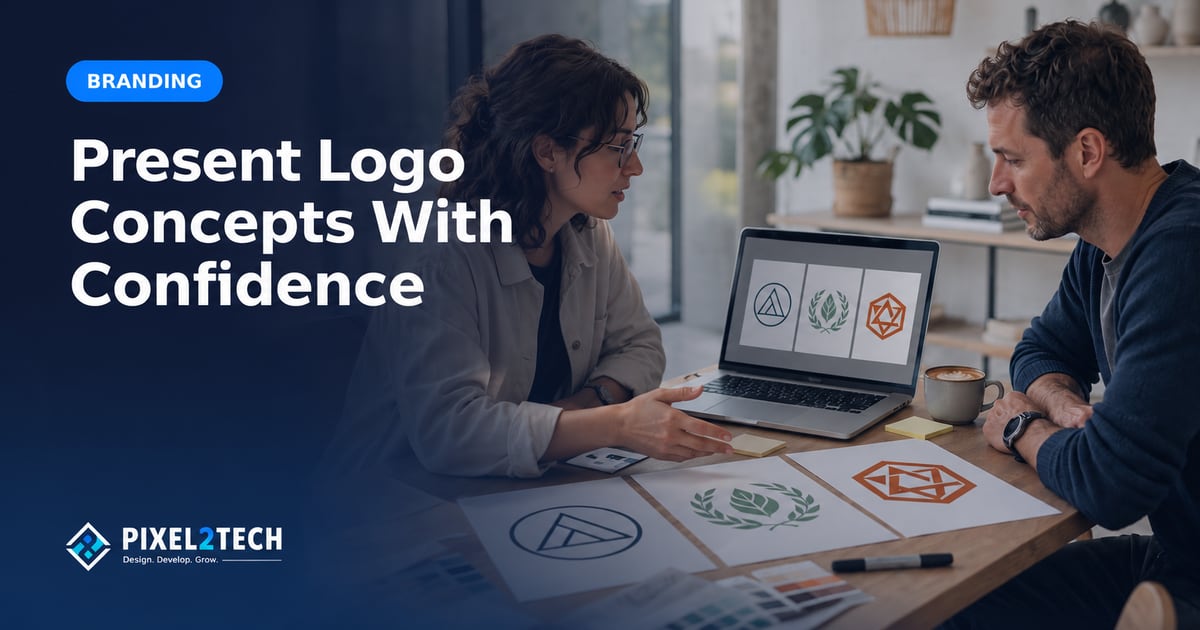
A logo presentation fails when the client sees three random marks and has to guess which one is right. The client is not a designer, so an open choice with no guidance feels like a test, not a decision. Approvals come faster when the presentation answers the question the client is really asking: which logo will customers recognise, trust, and remember. Show two or three strong concepts, explain each one in plain language, show each one where customers will actually see it, and end with one clear next step.
The number of concepts matters more than most designers admit. Ten concepts look generous, but they turn a decision into a search. The client compares tiny differences, loses track of the brief, and asks for a mix of three ideas that were never meant to work together. Two or three concepts keep the meeting focused on real choices.
Each concept should be a complete direction, not a variation of the same idea. One might be bold and modern, one might be calm and classic, and one might be simple and friendly. They should feel different enough that the client can say what they like and what they do not like about each one. If two concepts look almost the same, drop one of them before the meeting.
Prepare the set the same way every time. Give each concept a short name, such as Concept A, Concept B, and Concept C, so the client can refer to it easily. Keep the names neutral, because a clever name can bias the discussion before the logo has been judged on its own merits.
Explain each concept in plain language
A logo without reasoning is just a shape on a screen. The client needs to hear, in plain words, why this mark fits their business. Explain the idea behind it in two or three sentences. Say what the shape or symbol means, why the colours were chosen, and how the type style matches the business, whether that is a law firm in New York, a cafe in Los Angeles, or a consultancy in Dubai.
Avoid design jargon in the meeting. Words like kerning, grid, and negative space mean little to a client, and they can make the designer sound distant. Say instead that the mark stays readable at small sizes, that the colour works on a dark background, or that the shape is easy to remember after one look. Every claim should connect to something the client cares about: recognition, trust, or use across real places.
Write the reasoning down on the slide or the page, next to the logo. When the client reviews the concepts later, the written reasoning does the talking for you. A client who reads the reasoning again at home is more likely to approve than one who only remembers a picture.
Show the logo where customers will see it
A logo on a white slide tells the client almost nothing about how it will perform. Show each concept in its real homes: the website header, a social media avatar, a business card, an email signature, and a shop sign or a van, if that applies. A mark that looks strong on a slide can fail as a tiny avatar, and a mark that looks plain on a slide can look confident on a sign.
Use realistic mockups, not dramatic ones. The goal is an honest preview, not a sales trick. Show the logo in one colour, in black and white, and at the smallest size it will ever appear. If a concept fails any of those tests, fix it before the meeting or drop it, because the client will find the weakness sooner or later.
This step also answers the most common client worry: will it work everywhere. When the client sees the logo working in five real places, that worry fades. The discussion moves from taste to fit, which is where good decisions happen. For a useful check on what to keep and what to change in an existing mark, read A Logo Refresh Checklist: Keep, Change, Test.
Name your recommendation and say why
Many designers present concepts as equals and let the client choose alone. That feels polite, but it slows the decision, because the client has no way to weigh the options. The designer has spent hours on the work and knows which concept solves the brief best. Say so, clearly and honestly.
Name one concept as your recommendation and give two or three reasons for it. The reasons should come from the brief, not from personal taste. Say that it reads best at small sizes, that it matches the audience, or that it works in the most places. Then invite the client to disagree. A recommendation is not a command. It is a clear position the client can accept, adjust, or argue against, and any of those moves the project forward.
If the client prefers a different concept, listen for the reason. Sometimes the reason is a real problem with the recommended concept, and the choice should change. Sometimes the reason is a personal association, such as a colour the client dislikes, and that can be solved with a small adjustment. Either way, a recommendation gives the meeting something solid to discuss.
End with one simple decision step
A presentation that ends with "let us know what you think" will wait for days. End with one simple step instead. Ask the client to approve a direction, or to name one change they want in the recommended concept. Give a date for that answer, and say what happens next once it arrives.
Keep the feedback format simple too. Ask the client to pick one concept, name the one thing they would change, and name the one thing they would keep. That structure stops the long list of small changes that pulls a logo in three directions at once. If the client asks for a mix of two concepts, explain what would be lost in the mix before you agree to it.
After the meeting, send a short summary the same day: the concepts shown, the recommendation, the decision made, and the next step with a date. A short written record keeps the approval moving, even when the client is busy. It also protects the project from a second round of opinions that reopen a decision that was already made.
Frequently asked questions
How many logo concepts should I show a client?
Two or three strong concepts are enough for most projects. Each one should be a complete direction, different enough from the others that the client can compare real choices. More concepts slow the decision and invite the client to mix ideas that were never meant to work together.
Should I tell the client which concept I recommend?
Yes. Name one concept as your recommendation and give two or three reasons drawn from the brief. Clients approve faster when the expert takes a clear position, because they can accept it, adjust it, or argue against it, and each of those moves the project forward.
How do I present a logo so the client can judge it fairly?
Show each concept where customers will actually see it, such as a website header, a social media avatar, a business card, and a sign. Show it in one colour, in black and white, and at its smallest size. Explain each concept in plain language, without design jargon.
What should I do if the client wants to combine two concepts?
Ask what they like in each one, then explain what would be lost in the mix before you agree. Sometimes a small element can move across. Often the mix weakens both ideas. If the mix still makes sense, show it as a new concept with its own reasoning, rather than editing live in the meeting.
About the author: Asad Farooq
Co-Founder & COO
Pixel2Tech is a Lahore studio for brand, web, video and automation work. We write about problems we see in client projects.
More about AsadPresent your logo concepts with confidence
Pixel2Tech designs logos and brand systems for service businesses, and presents concepts with clear reasoning and real mockups so clients can approve with confidence. If your logo decisions keep stalling, a structured presentation is often the fix that gets the project moving again.
Related articles
Branding ·
How to Brief a Brand Designer So the First Concepts Land Close
A clear brand brief saves rounds of revisions. Here is what to tell your designer so the first concepts land close to the brand you want.

Branding ·
Portfolio Pieces That Win Clients: What to Show and What to Leave Out
A strong portfolio shows the work that matches the client in front of you. Here is how to choose the pieces to show, and which ones to leave out.
Branding ·
How to Write a Brand Story Customers Actually Remember
A brand story customers remember is short, specific and true. How to write one for a service business, from the problem you solve to the proof that backs it up.

Branding ·
How to Name a Service Business So Customers Remember It
A memorable service business name is short, easy to say on the phone, and easy to find online. A practical naming guide for service businesses, from the first shortlist to the final check.
Related Pixel2Tech services
Get new articles by email
Leave your email and we'll send new posts when they're published.