

Why Verified Wholesale Sourcing Beats Auctions and Liquidation Marketplaces
Cheap inventory is rarely the cheapest inventory. Here is why verified suppliers, escrow payments, managed logistics, and fixed wholesale pricing protect margins better than auctions and liquidation marketplaces.
- Written by Usama Farooq
- Topic: E-commerce
- Published
- 3 min read
Key takeaways
- The lowest auction price is not the lowest landed cost once returns, freight, and disputes are counted.
- Supplier verification removes the single biggest risk in wholesale sourcing: buying from an unknown seller.
- Escrow protection holds funds until the buyer confirms delivery, so accountability sits on both sides.
- Managed logistics — freight, customs, insurance, tracking — saves more hours than most buyers expect.
- Fixed wholesale pricing lets you calculate margin before you buy, instead of hoping a bid stays profitable.
- Repeatable supplier relationships beat one-time bargains for anyone planning long-term growth.
In this article (10 sections)
Cheap Inventory Is Rarely the Cheapest Inventory
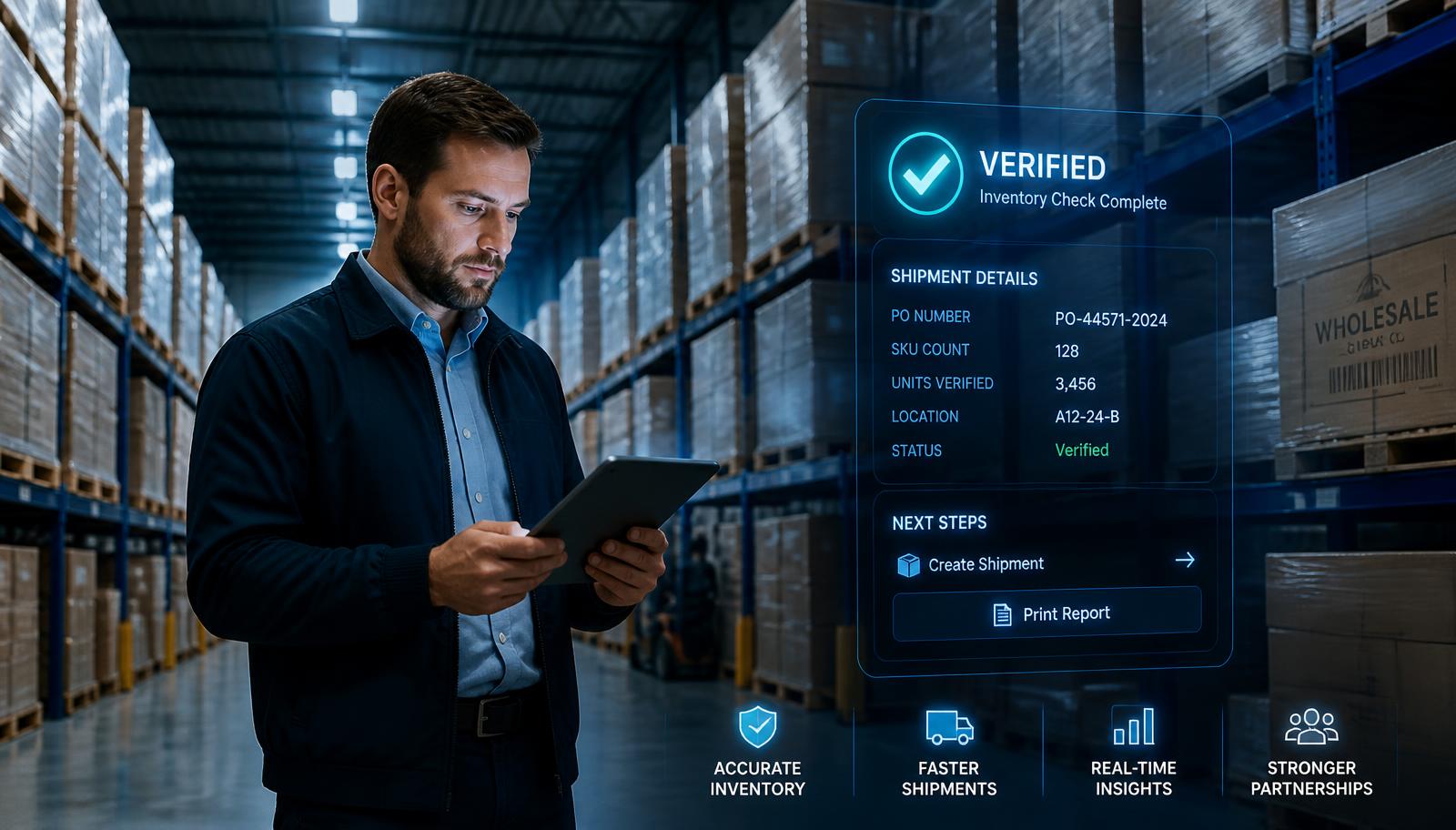
Verified wholesale sourcing is buying inventory through a platform that vets suppliers, secures payment, and manages logistics — instead of bidding blind on auction lots.
Choosing the right sourcing partner affects profit more than finding the lowest unit price. Whether you run an Amazon storefront, a retail chain, a wholesale operation, or a factory clearing overstock, sourcing is a risk decision as much as a price decision.
Liquidation marketplaces and online auctions look inexpensive at the top of the funnel. The real number appears later, once damaged units, wrong counts, unexpected freight, and slow refunds have been subtracted from the spread you thought you had.
A verified sourcing network takes the opposite approach: fewer surprises, known suppliers, and a landed cost you can calculate before you commit.
Why Supplier Verification Matters
Supplier verification checks a seller's identity, trading history, and inventory accuracy before they are allowed to list.
The single biggest risk in wholesale sourcing is buying from someone you cannot evaluate. Auction platforms rarely give you more than a username and a rating that may be thin or gamed.
A verified network removes most of that uncertainty because approval happens before inventory reaches the buyer. That changes how confidently you can scale order size.
- Higher inventory accuracy against the manifest
- More reliable, repeatable transactions
- Better long-term supplier relationships
- Materially reduced fraud risk
- Confidence to place larger, higher-value orders
Escrow Protection Creates Safer Transactions
Traditional marketplaces usually want payment up front. If the pallet arrives damaged or does not match the listing, recovering the money becomes a slow argument you may not win.
Escrow changes the order of events so that payment follows delivery confirmation, not the other way round.
- Buyer places the order
- Funds are held securely by a neutral party
- Supplier ships and products are delivered
- Buyer inspects and confirms the shipment
- Payment is released to the supplier
Logistics Should Not Be Your Biggest Challenge
International wholesale shipments have a lot of moving parts, and each one is a place where a schedule slips: freight coordination, customs documentation, insurance, carrier selection, and delivery tracking.
Handling all of that yourself is a part-time job that produces no revenue. When the sourcing partner coordinates logistics, your team spends its hours on merchandising, pricing, and selling — the activities that actually compound.
Fixed Wholesale Pricing vs Auction Bidding
Auction platforms create unpredictable pricing by design. Competitive bidding regularly drives lots past the point of profitable resale, and the winner is often simply the buyer who miscalculated most optimistically.
Fixed wholesale pricing makes purchasing a planning exercise instead of a gamble.
| Factor | Auction / liquidation | Verified fixed-price sourcing |
|---|---|---|
| Unit cost | Unknown until bidding closes | Published before you commit |
| Margin calculation | Estimated, often after purchase | Calculated on known landed cost |
| Inventory condition | Manifest quality varies | Verified against supplier record |
| Payment risk | Usually paid up front | Escrow released after delivery |
| Restock consistency | Opportunistic and irregular | Repeatable from known suppliers |
Who Benefits Most From Verified Wholesale Sourcing
Verified sourcing suits any business whose profit depends on inventory arriving as described, on time, at a known cost.
Retailers
Source closeout and overstock inventory for physical stores with far more confidence in condition and count.
Marketplace sellers
Keep listings in stock across Amazon, Walmart, Shopify, and eBay without depending on whatever happens to appear at auction this week.
Wholesalers and distributors
Build relationships with verified suppliers who can support volume growth rather than one-off lots.
Manufacturers
Move excess inventory, discontinued lines, factory seconds, and overstock through a trusted network of qualified buyers.
Relationship-Based Sourcing Wins Over Time
Successful wholesale businesses rarely run on one-time purchases. They build repeatable supply chains where the same suppliers deliver predictable inventory month after month.
Working inside a verified network accelerates that, because the trust layer is already established before the first conversation.
- Better pricing as volume and history build
- Consistent inventory availability
- Faster fulfilment and fewer stockouts
- Easier negotiation on terms and payment
- Improved long-term profitability
Final Thoughts
Wholesale sourcing has moved past hunting for the lowest number on a screen. Modern operators need reliable suppliers, secure payment, professional logistics, and transparent transactions — because those are what protect margin at scale.
A verified sourcing platform such as GWS Connect 24 offers a safer alternative to auction sites and liquidation marketplaces: buyers reduce risk, suppliers reach qualified businesses, and both sides get transactions they can repeat.
If the goal is long-term growth rather than one-time bargains, the sourcing partner you choose becomes one of your strongest competitive advantages.
Sources and further reading
Frequently asked questions
What is verified wholesale sourcing?
Verified wholesale sourcing means buying inventory through a platform that reviews and approves suppliers before they can list products. Supplier identity, business history, and inventory accuracy are checked up front, so buyers are not gambling on an unknown seller.
Is liquidation inventory worth buying?
It can be, but only when you can inspect the manifest, verify condition grading, and absorb a percentage of unsellable units. Liquidation marketplaces work best as an occasional opportunistic channel — not as the backbone of a store that needs consistent stock.
How does escrow protect a wholesale buyer?
Funds are held by a neutral third party instead of being paid straight to the supplier. Payment releases only after the buyer confirms the shipment arrived as described, which removes most of the recovery risk on a first order with a new supplier.
Why is fixed wholesale pricing better than auction bidding?
Fixed pricing lets you calculate landed cost and resale margin before committing. In an auction, competitive bidding regularly pushes the winning price past the point where the lot can be resold profitably.
Which businesses benefit most from a verified sourcing platform?
Retailers buying closeout inventory, marketplace sellers on Amazon, Walmart, eBay, and Shopify who need consistent restocks, wholesalers building long-term supply, and manufacturers clearing overstock or discontinued lines.
About the author: Usama Farooq
CEO & Founder
Pixel2Tech is a Lahore studio for brand, web, video and automation work. We write about problems we see in client projects.
More about UsamaBuilding a sourcing or B2B platform of your own?
We design and build B2B storefronts, supplier portals and inventory automation, including verification workflows, escrow-style payments and shipment tracking.
Related articles
E-commerce ·
Headless Shopify: A Practical Guide for Founders and eCommerce Brands
What headless Shopify actually means, when it is worth the cost, when a well-built theme wins, and how to plan the move without breaking revenue.
AI ·
Why Modern Brands Need an AI Ops Layer
The teams that win in the next 5 years will run on AI-native workflows.
Business ·
Your Business Doesn't Need More Software. It Needs Better Systems.
Most businesses don't have a technology problem—they have a systems problem. Adding another tool rarely fixes friction; sometimes it makes it worse. Here is how to build connected systems that actually scale.
Web Development ·
Why Every Business Needs a Modern Website in 2026
A 10-point audit to figure out if your website is helping or hurting.


Related Pixel2Tech services
Get new articles by email
Leave your email and we'll send new posts when they're published.